
The Hidden SEO Factor Nobody Talks About in 2026
Everyone who has ever typed "how to rank on Google" has gotten the same recycled advice: use keywords, write blogs, get backlinks. Sound familiar? Here's the uncomfortable truth: that advice isn't wrong it's just incomplete. In 2026, Google's ranking algorithm has grown far more sophisticated, and there's one major SEO factor that almost nobody in Nepal's digital space is talking about. That factor? Website development quality. Not the design. Not the logo. The actual technical foundation of how your website is built, how fast it loads, how it behaves on a mobile screen in Pokhara with a 4G connection, and how Google's AI-powered crawlers interpret your content. This article breaks down the hidden SEO factors shaping rankings in 2026, why Nepalese businesses must urgently embrace digitization, and what modern SEO strategies actually look like beyond just chasing keywords.
The State of Digital Business in Nepal: A Fast-Moving Train
Nepal's digital economy has been growing at a pace that surprises even regional analysts. According to the Nepal Telecommunications Authority (NTA), internet penetration in Nepal crossed 90% in 2024, with mobile internet users forming the overwhelming majority. This isn't a future trend it's the present reality. Yet, a significant portion of Nepalese businesses especially small and medium enterprises (SMEs) still operate with either no website, a poorly maintained one, or a static page that hasn't been touched since 2018. That gap is a massive opportunity. And it's closing fast.Why Nepalese Businesses Are Going Digital
Several factors are accelerating digitization across Nepal:-
Post-pandemic behavioral shifts: Consumers in Kathmandu, Pokhara, and even smaller cities like Butwal and Birgunj now search online before buying anything, from trekking gear to legal services.
-
E-commerce growth: Platforms like Daraz, HamroBazaar, and local D2C brands are proving that online selling works in Nepal's market.
-
Government push: The Government of Nepal's Digital Nepal Framework aims to digitize 75 government services and accelerate private sector adoption.
-
Youth demographics: Over 40% of Nepal's population is under 25. They don't read newspapers they scroll.
What Is the Hidden SEO Factor in 2026?
Let's get specific. The hidden SEO factor that separates top-ranking websites from everyone else in 2026 is Core Web Vitals combined with AI-readable website architecture, both of which are products of how well your website is developed. Google officially uses Core Web Vitals as ranking signals. These include:-
Largest Contentful Paint (LCP): How fast the main content of your page loads. Google recommends under 2.5 seconds.
-
Interaction to Next Paint (INP): How quickly your site responds when a user clicks or taps something. Replaced the older FID metric in 2024.
-
Cumulative Layout Shift (CLS): Whether your page elements jump around while loading, deeply frustrating on mobile.
Why This Is an Overlooked SEO Ranking Signal
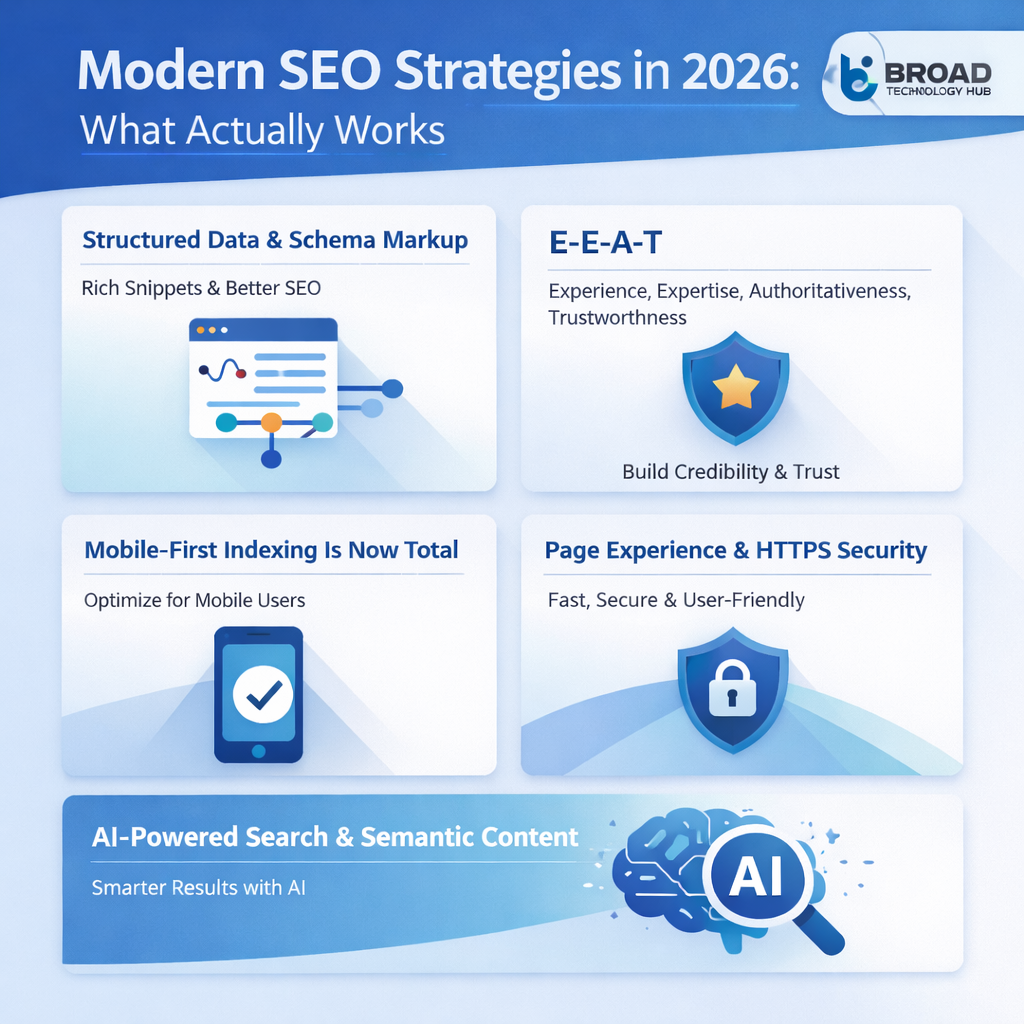
Most digital marketers in Nepal focus on content and backlinks. Both matters. But if the technical foundation the website development layer is weak, all that content and link-building effort sits on a crumbling base. Google's John Mueller has repeatedly stated in public communications that technical SEO is the prerequisite, not the afterthought. You can write 500 perfect blog posts. If your site is slow, insecure, or built without proper schema markup, Google simply won't trust it enough to rank it well.Modern SEO Strategies in 2026: What Actually Works
1. Structured Data and Schema Markup
Schema markup is code you add to your website to help search engines understand your content contextually not just literally. In 2026, with AI-powered search engines becoming dominant, structured data is no longer optional. It's a competitive necessity. For a Nepali travel agency, this might mean marking up your tour packages with schema that tells Google the price, duration, location, and customer ratings. This can unlock rich snippets in search results those star ratings and price previews that dramatically increase click-through rates.2. E-E-A-T: Experience, Expertise, Authoritativeness, Trustworthiness
Google updated its quality guidelines to include "Experience" as a new dimension making it E-E-A-T instead of the older E-A-T. What this means practically:-
Content written by someone with real experience in the subject ranks better
-
Author pages, professional bios, and verified credentials on your website signal trustworthiness
-
For Nepalese businesses, this means showcasing your team, your certifications, your client testimonials and making sure your website development supports displaying all of this cleanly
3. Mobile-First Indexing Is Now Total
Google fully moved to mobile-first indexing. This means Google predominantly uses the mobile version of your content for indexing and ranking. If your website looks fine on a desktop but breaks on a Redmi Note screen, you're being ranked based on the broken version. Nepal's mobile internet usage far outpaces desktop usage. Building a website that isn't mobile-first in 2026 is the digital equivalent of opening a shop with a door too small to enter.4. Page Experience and HTTPS Security
Google confirmed that HTTPS is a ranking signal. A website without SSL certification doesn't just look untrustworthy to users google actively deprioritizes it. For Nepali business websites still running on HTTP, this is a quick and non-negotiable fix.5. AI-Powered Search and Semantic Content
Google's AI systems, particularly the Search Generative Experience (SGE) and MUM model, understand content semantically meaning they grasp intent and context, not just keyword matching. This is why keyword stuffing died years ago and why future of SEO belongs to content that comprehensively answers real questions. For businesses in Nepal, this means writing content that addresses the real problems your customers have in plain, helpful language rather than gaming keyword density.Why Nepal's Businesses Need Digitization Now, Not Later
The argument for digitization in Nepal isn't theoretical. It's urgent and mathematical. According to the World Bank's 2023 report on South Asia's digital economy, countries that accelerate SME digitization see an average GDP contribution increase of 1.5–2.5% from the digital sector within five years. Nepal's Finance Ministry has acknowledged digital entrepreneurship as a key pillar of economic growth in successive budgets. Here's what businesses stand to gain from going digital properly meaning with quality website development and strong SEO:-
24/7 visibility without paying for physical signage or staff
-
Reach beyond geography, a carpet seller in Bhaktapur can sell to a buyer in Berlin
-
Data-driven decisions through Google Analytics, which tells you exactly what your customers want
-
Lower customer acquisition cost compared to traditional advertising
-
Credibility, 75% of users admit to judging a company's credibility based on its website design
What Good Website Development Actually Looks Like in 2026
Great website development for SEO in 2026 means building with the following fundamentals:-
Fast loading speeds - optimized images, clean code, reliable hosting
-
Responsive design- seamlessly adapts across all screen sizes
-
SSL certificate - secure HTTPS connection as standard
-
Clean URL structure - logical, readable, and keyword-relevant URLs
-
Schema markup integration - structured data for enhanced search visibility
-
Proper heading hierarchy- H1, H2, H3 used meaningfully, not decoratively
-
Internal linking structure - connecting related content to help Google crawl your site efficiently
-
Accessible design - usable by people with disabilities, which Google also rewards
-
Fast server response times - choosing good hosting matters more than most realize